Plinth & Worktop (Project)
These settings are project-wide (for the whole carcass run), not per carcass. You'll find them in the left sidebar under the Project tab. This is where the Placement (gaps), the plinth, the worktop and the export tolerance live.
Placement
- Gap between carcasses (0–50 mm): the space between adjacent
carcasses along the run.
0butts them together. Where two carcasses meet, they share their reveal (each side steps back by half the gap, so the two fronts meet with one reveal).
Export (3D/STEP)
- Joint clearance (0–2 mm, step 0.05):
the fit clearance at interlocking joinery (dovetail/box joint/groove) in the
STEP export.
0= exact press fit; higher values give a looser glue/assembly fit. Affects only the CAD export, not the cut list dimensions.
Plinth
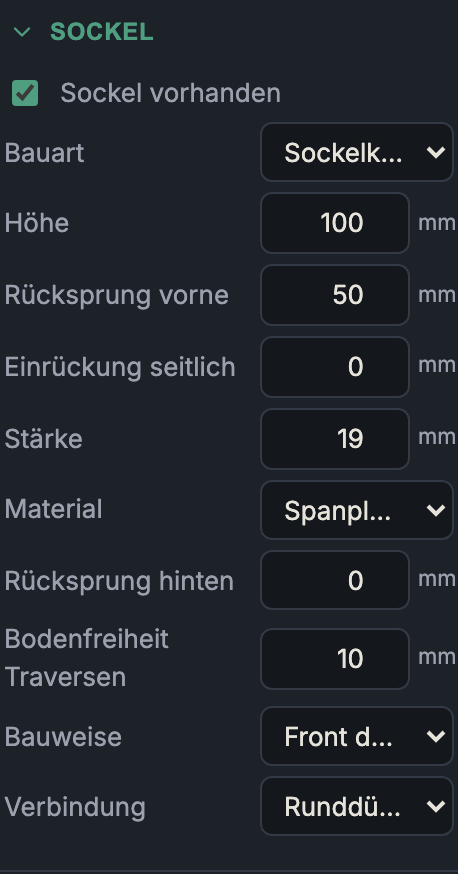
- Plinth present: Places a plinth under the carcasses that have "Stands on plinth" set. Only then is this carcass option even available.
Type
- Plinth box: A complete plinth frame (sides + cross stretchers + plinth front + rear). The sturdy standard plinth.
- Front only (adjustable legs): Only the front plinth panel
(toe-kick); the carcass is carried by adjustable legs (e.g. Axilo), onto
which the front is clipped.
- Pros & cons: Adjustable legs compensate for uneven floors and allow a light, material-saving construction; the plinth box is stiffer and more enclosed.
Dimensions
- Height (40–250 mm, default 100 mm): plinth height (= how far the carcass is raised).
- Front setback (0–150 mm, default 50 mm): how far the plinth front steps back from the carcass front edge (foot clearance/toe-kick).
- Side inset (0–150 mm): how far the plinth is inset at the ends of the run.
- Thickness (12–40 mm): material thickness of the plinth parts.
- Material: material of the plinth.
Plinth box only
- Rear setback (0–150 mm): how far the plinth steps back at the rear. A back panel slid in from below forces at least its own clearance.
- Stretcher ground clearance (0–40 mm, default 10 mm): the inner cross stretchers end far enough above the floor that only the outer sides and the front panel rest on it — more forgiving on uneven floors.
- Construction:
- Front through: the front (and rear) run through, with sides/stretchers between them — a clean, continuous plinth front.
- Sides through: the sides run the full depth, with front/rear between them.
- Joinery: how the plinth frame parts are joined (dowel/Domino/ biscuit/screws/groove — as with the carcass joinery).
Worktop
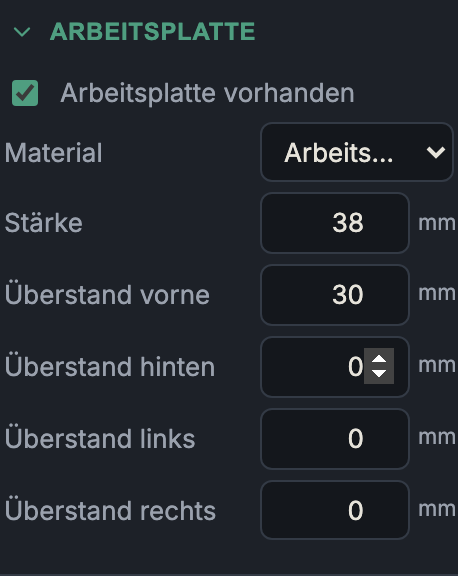
- Worktop present: Enables a worktop; only then is the carcass option "With worktop" usable. The worktop sits on the top edge of the respective carcasses.
- Material / thickness (12–80 mm, default 38 mm): worktop material and thickness.
- Overhang front / rear (0–150 mm): overhang past the carcass front/rear edge (front is usually ~30 mm for a drip edge).
- Overhang left / right (0–300 mm): side overhang at the start/end of the run (e.g. for a worktop that overhangs at the side).
The worktop is laid over the carcass run; with the overhangs you shape a continuous, spanning worktop.